Last Updated: November 14, 2026
Quick Summary
A hardwired ev charger delivers up to 48 amps, seals the connection for outdoor safety, and removes a common failure point, while a plug-in unit on a NEMA 14-50 outlet usually caps at 40 amps but is easier to replace. Choose based on your panel capacity, parking spot, and your vehicle's onboard charger rating.
- A plug-in EV charger connects to a NEMA 14-50 outlet on a dedicated circuit.
- Check your vehicle's onboard charger rating before paying for 48-amp capacity.
- Hardwiring usually wins for outdoor or detached garage installations.
- An electrician can perform a load calculation to check your panel's capacity.
- Load management can sometimes avoid a full panel upgrade.
Table of Contents
- Hardwired vs Plug-In EV Charger: The Core Trade-Off
- What Does Hardwired EV Charger Mean?
- Can I Just Plug My EV Into a 240V Outlet?
- Charging Speed and Amperage: 40 Amps vs 48 Amps
- Hardwired vs Plug-In EV Charger for Home Use Cost
- Best Hardwired EV Charger Options and What to Look For
- Panel Capacity, Load Management, and Permits
- Request a Quote for Your EV Charger Installation
- Frequently Asked Questions
Hardwired vs Plug-In EV Charger: The Core Trade-Off
If you are deciding between a hardwired versus plug in EV charger for home use, the short answer is this: hardwiring gives you more power, a safer outdoor connection, and a cleaner install, while a plug-in unit gives you flexibility and easier replacement. The decision usually comes down to your electrical panel, your parking spot, and how much charging speed you actually need.
The real question is not which charger is "better" in general. It is which one your home's electrical system can support without a costly surprise.
Below, we break down the trade-offs, the amperage limits, and the cost drivers so you can choose with confidence.
How the Two Setups Differ at a Glance
A hardwired EV charger connects directly to a dedicated 240-volt circuit with no plug or receptacle in between. A plug-in EV charger uses a cord and plug that connects to a NEMA 14-50 outlet on a dedicated circuit.
| Feature | Hardwired | Plug-In |
|---|---|---|
| Connection | Direct wiring to circuit | NEMA 14-50 outlet and plug |
| Typical max amperage | Up to 48 amps | Usually capped at 40 amps |
| Outdoor weather resistance | Higher, sealed connection | Depends on outlet and enclosure |
| Portability | None, fixed in place | Can unplug and move |
| Replacement ease | Requires an electrician | Swap the unit yourself |
| GFCI protection | Breaker-level | Required at the receptacle |
What Does Hardwired EV Charger Mean?
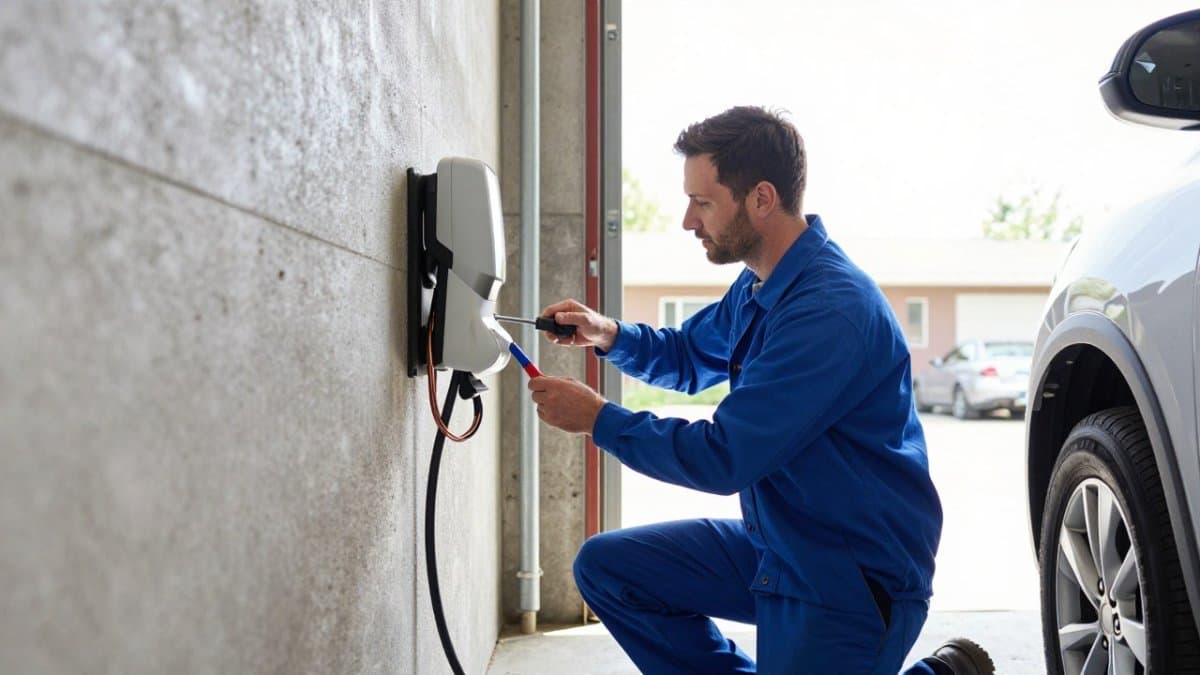
A hardwired EV charger is a charging station permanently wired into your home's electrical system on a dedicated circuit, with no plug connection. Because there is no receptacle, the connection is sealed and can safely carry higher amperage.
That direct connection is why hardwired units can run at 48 amps while most plug-in setups top out at 40. It also removes a common failure point. A plug and outlet can loosen, corrode, or wear out over years of use. A hardwired connection does not.
Hardwiring is often the better choice outdoors because the connection is sealed rather than exposed at a receptacle.
Can I Just Plug My EV Into a 240V Outlet?
Yes, you can plug an EV into a 240V outlet, but only with the right outlet, circuit, and charger. A standard household 120V outlet will charge an EV, but painfully slowly. A dedicated 240-volt circuit is what makes home charging practical.
NEMA 14-50 Receptacles, Breakers, and GFCI Protection
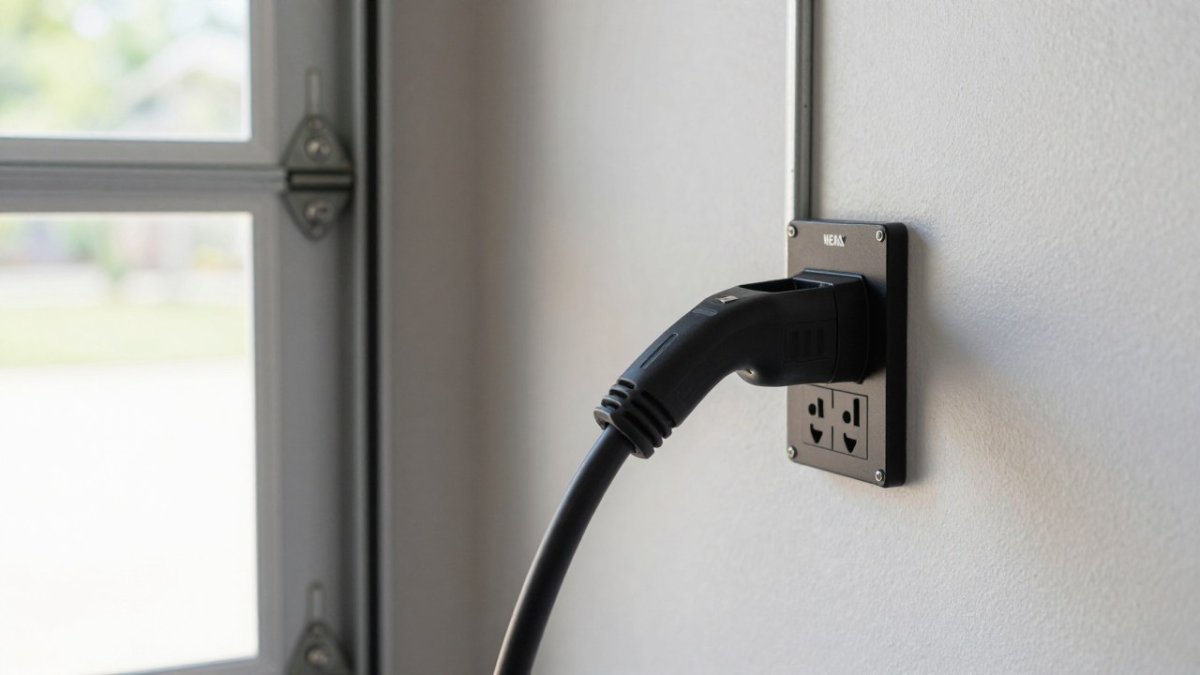
The NEMA 14-50 is the standard receptacle for plug-in home charging. It is a four-prong outlet that provides two hot wires, a neutral, and a ground, and it must sit on its own dedicated circuit with an appropriately sized breaker.
Safety details matter here. The National Electrical Code requirements for EV branch circuits call for ground-fault circuit protection on the receptacle, and the outlet needs to be rated for continuous duty. A cheap receptacle not designed for EV loads can overheat.
Watch out: plugging a 40-amp charger into an old dryer outlet or a circuit shared with other appliances is a genuine fire risk. The circuit must be dedicated and sized correctly.
Charging Speed and Amperage: 40 Amps vs 48 Amps
Charging speed comes down to amperage. A 48-amp hardwired charger delivers more power per hour than a 40-amp plug-in unit, which means more miles added overnight.
The catch is your vehicle. Your car's onboard charger caps how much power it can accept, so a 48-amp station will not help if your EV tops out at 32 or 40 amps. Check your vehicle's onboard charger rating before paying for extra capacity you cannot use.
There is also the continuous load rule. Because EV charging runs for hours, the circuit and breaker must be sized above the charger's rated draw, which is why a 48-amp charger needs a larger breaker than a 40-amp one.
Hardwired vs Plug-In EV Charger for Home Use Cost
Total installed cost depends far more on your electrical setup than on the charger itself. The unit is one line item; labor, wiring runs, permits, and any panel work are the rest. To compare hardwired versus plug-in fairly, you need to estimate the full project, not just the hardware.
A Realistic Cost Breakdown
Neither option is automatically cheaper; the deciding factor is usually whether your panel has capacity and how far the parking spot is from it.
Decision Framework Based on Your Existing Electrical Setup
Use your current setup to narrow the choice before you call an electrician:
- Existing 240-volt circuit with adequate capacity: A plug-in unit on a new dedicated receptacle is often the lowest-labor path, provided the circuit is dedicated and correctly sized.
- No 240-volt circuit, panel has capacity: Either option works; hardwiring may cost slightly more in labor but can support higher amperage if your vehicle allows it.
- Panel near its limit: Budget for load management or a panel upgrade before comparing charger types, this cost dominates the decision.
- Outdoor or detached garage: Hardwiring usually wins on weather resistance and long-term reliability, even at a modest labor premium.
Because pricing depends on your specific home, we do not quote blind. For real figures on what a panel upgrade can add, see our breakdown of electrical panel upgrade cost.
Best Hardwired EV Charger Options and What to Look For
The best hardwired EV charger is one that matches your vehicle's onboard charger, your panel capacity, and your parking setup. Rather than chase a brand name, focus on the specs that decide performance and safety.
Look for these features:
- Adjustable amperage so you can dial down to match your circuit
- A NEMA-rated outdoor enclosure if the charger lives outside
- A reputable safety certification on the unit
- Load management capability if your panel is tight
- A cord long enough to reach your parking spot without strain
A common mistake is buying the highest-amp charger available without confirming the vehicle and panel can support it. Match the charger to your system, not to the spec sheet.
Panel Capacity, Load Management, and Permits
Your electrical panel is the deciding factor in most installs. Every home has a limited amount of available capacity, and an EV charger adds a large continuous load. If your panel is already near its limit, adding a charger without a plan can trip breakers or fail inspection.
How to Tell If Your Panel Has Capacity
A licensed electrician can perform a load calculation to compare your home's existing demand against the panel's rating. Common warning signs that capacity is tight include a panel with no open breaker spaces, a service rated at 100 amps or less, frequent breaker trips, or a panel that is already handling large loads such as electric range, dryer, and central air. If any of these apply, plan for load management or an upgrade before choosing between hardwired and plug-in.
Load Management as an Alternative to a Panel Upgrade
A load-management device lets a charger share capacity with existing appliances by reducing charging power when the home's demand spikes, which can sometimes avoid a full panel upgrade. Load sharing between two chargers works the same way. Not every situation allows it, the device must be compatible with your panel and charger, and your local authority must accept the approach, but it is worth asking about before committing to a service upgrade.
Permits, Inspections, and Code Considerations
Permits and inspection are not optional, and a licensed electrician can handle the permit and scheduling process. Requirements vary by jurisdiction, so confirm with your electrician or local building authority what applies to your address. The National Electrical Code requirements for EV branch circuits set the baseline for circuit sizing, breaker protection, and ground-fault protection, but local amendments can be stricter.
A Practical Safety Checklist
Before and after installation, verify these items:
- Circuit sizing: The circuit and breaker are sized above the charger's continuous draw, per the continuous-load rule.
- Breaker protection: The breaker matches the wire and charger rating; no undersized breaker on a high-amp charger.
- GFCI protection: Ground-fault protection is present where required for the receptacle or circuit.
- Outdoor ratings: Any outdoor receptacle or enclosure is rated for wet locations and continuous EV duty.
- Professional installation: The work is performed and inspected by a licensed electrician, with the permit closed out.
If you are unsure whether your panel can handle the load, our guide on whether your home needs a panel upgrade for an EV charger walks through the warning signs, and our team handles panel replacement and 200 amp upgrades when an upgrade is the right call.
Request a Quote for Your EV Charger Installation
The safest path to a charger that passes inspection and performs for years is a licensed install planned around your actual electrical system. We size the circuit, check your panel, pull the permit, and walk you through the scope before any work begins.
S&T Electrical Solutions is led by a Washington Master Electrician and provides residential electrical contracting services for the Wenatchee Valley. If you are ready to move forward, request a quote for your EV charger installation or tell us about your electrical project and we will get back to you.
Adding a home charger is a straightforward job when it is planned around your panel and your vehicle, and a frustrating one when it is not. Do not guess at your capacity or cut corners on the circuit. Get a licensed electrician to check your panel, size the circuit correctly, and handle the permit and inspection. Get started with S&T Electrical Solutions and charge at home with a setup built to code and built to last.
Frequently Asked Questions
Is it better to hardwire or plug in an EV charger?
It depends on your panel and your goals. A hardwired EV charger supports up to 48 amps on a 60-amp breaker, giving faster charging and a sealed connection that holds up outdoors. A plug-in charger on a NEMA 14-50 outlet caps at 40 amps but is easier to replace or move. If your panel has spare capacity and you want maximum speed, hardwiring usually wins. If flexibility matters more, a plug-in setup works well.
Can I just plug my EV into a 240V outlet?
Yes, if the outlet is a dedicated 240-volt circuit rated for continuous load and installed for EV charging. A NEMA 14-50 receptacle on a 50-amp breaker is the common choice, and the charger draws no more than 40 amps continuously. Avoid sharing the circuit with a dryer or range, and confirm GFCI protection and permit requirements with a licensed electrician before plugging in.
Does a hardwired EV charger charge faster than a plug-in charger?
It can. A hardwired unit on a 60-amp breaker delivers 48 amps, while most plug-in chargers max out at 40 amps on a 50-amp circuit. That difference shortens charge times, but your vehicle's onboard charger is the real ceiling. Many EVs accept only 32 to 48 amps, so check your car's limit before paying for extra capacity you cannot use.
Can I switch a plug-in EV charger to a hardwired installation later?
Yes, and it is a common upgrade. An electrician removes the receptacle, connects the charger directly to the circuit, and adjusts the breaker and settings to match the new amperage. Confirm the wire gauge supports the higher amperage before making the switch.