
Last Updated: November 1, 2026
Quick Summary
Whether your home needs a panel upgrade for an EV charger depends on your existing service size and spare capacity after normal household load. Many 200-amp homes can add a Level 2 charger without a service upgrade, while many 100-amp homes need load management or a service upgrade. A load calculation is the standard way to check whether a panel has room for a charger.
- A 48-amp charger needs a 60-amp breaker because EV charging counts as a continuous load.
- A 100-amp panel with electric range, dryer, and central AC usually calls for a service upgrade.
- Load management reduces charging current when household demand spikes, then restores full speed overnight.
- A 16-amp Level 2 charger delivers roughly 12 to 15 miles of range per hour.
- Ask your electrician for the calculated available capacity before accepting a service upgrade recommendation.
Table of Contents
- How to Tell If Your Home Needs Panel Upgrade for EV Charger
- Level 1 vs Level 2 Charging and What Each Demands From Your Panel
- Running a Load Calculation for EV Charger Capacity
- 100-Amp vs 200-Amp Panels: When Each Is Enough
- Getting an EV Charger Without Panel Upgrade Work
- What Home EV Charger Installation Cost and EV Charger Installation Time Look Like
- How to Tell If Your Home Needs a Panel Upgrade for an EV Charger: Evaluating the Recommendation
- Frequently Asked Questions
How to Tell If Your Home Needs Panel Upgrade for EV Charger
The short answer to "does my home need panel upgrade EV charger" questions: it depends on your existing service and spare capacity after normal household load.
A panel upgrade is the replacement of your electrical service panel, and often the service entrance wiring, to handle more load than the current setup supports. It should follow a real assessment, not a sales pitch.
Here is a practical sequence for deciding:
- Identify your service size (100-amp, 150-amp, or 200-amp panel).
- Add up existing loads: HVAC, range, dryer, water heater, and any large equipment.
- Calculate available capacity left for continuous EV charging.
- Compare that number to what your charger requires.
- Choose between a smaller charger, load management, or a service upgrade.
Level 1 vs Level 2 Charging and What Each Demands From Your Panel
Level 1 charging uses a standard 120-volt household outlet and adds roughly 3 to 5 miles of range per hour. Level 2 charging uses a 240-volt dedicated circuit and typically delivers 20 to 30 miles of range per hour, depending on the vehicle and charger amperage.
The panel impact differs enormously. A Level 1 charger draws about 12 amps continuously, which most panels absorb without complaint.
That is where panels get stressed: a 40-amp charger draws the equivalent of a central air conditioner running for hours, making your car one of the largest loads in the house.
Best for: overnight commuters who drive under 40 miles daily can often stay on Level 1. Skip Level 1 if: you drive more than that or want to recover charge quickly between trips.
Running a Load Calculation for EV Charger Capacity
A load calculation for EV charger capacity is the math that determines whether your panel can safely carry the new charging circuit alongside everything else.
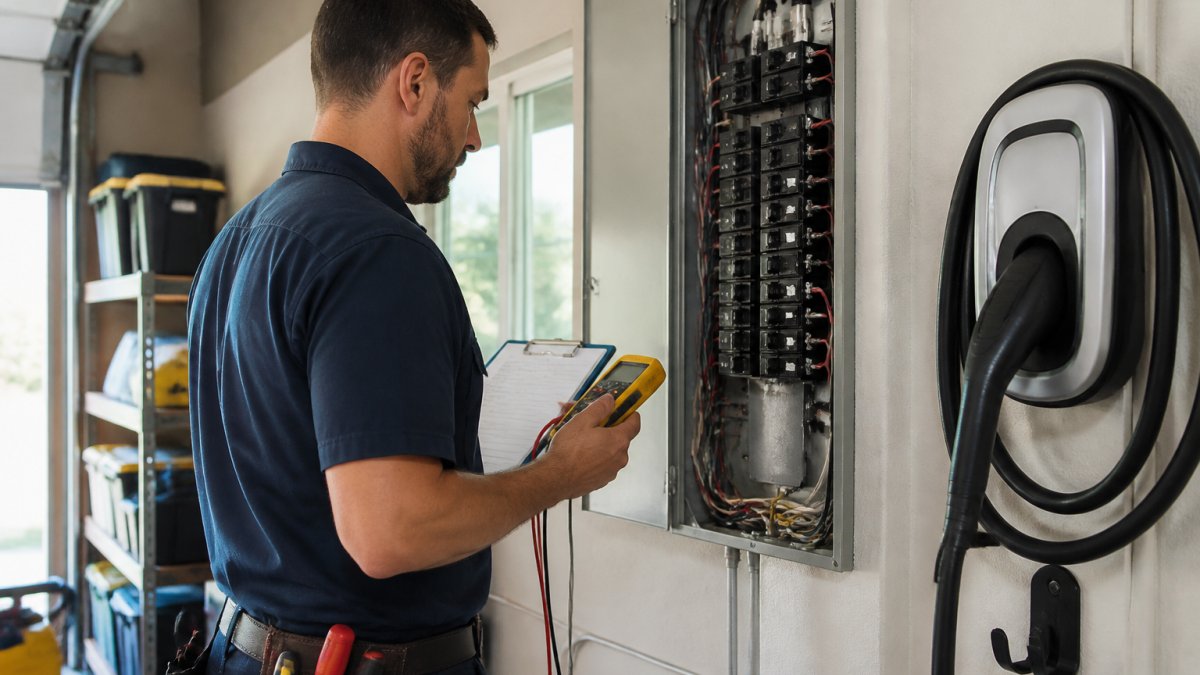
The process works like this:
- General lighting and receptacles: 3 volt-amperes per square foot of living space.
- Small appliance and laundry circuits: fixed allowances per circuit.
- Fixed appliances: range, dryer, water heater, and similar loads with code demand factors applied.
Subtract the total from your service rating and you get available capacity. If the remainder comfortably covers the charger, you are done.
The calculation is not a formality. The National Electrical Code requirements published by NFPA are what your inspector will check the installation against, and an undersized calculation is the most common reason an EV charger fails inspection.
100-Amp vs 200-Amp Panels: When Each Is Enough
A 100-amp panel is usually sufficient for a Level 1 charger or a low-amperage Level 2 charger paired with load management. A 200-amp panel is generally required for a full 48-amp Level 2 charger in a home with electric heating, electric range, or electric water heater. But service size alone does not answer the question: two homes with the same 100-amp service can land on opposite sides of the upgrade decision depending on what else is drawing power.
The table below gives a general starting point, not a verdict:
| Service Size | Typical Home Profile | Level 2 Charger Outlook |
|---|---|---|
| 100-amp | Older home, gas appliances, no central AC | Low-amperage charger or load management likely needed |
| 100-amp | Electric range and dryer, central AC | Service upgrade usually recommended |
| 150-amp | Mixed appliances, moderate square footage | Often workable with load management |
| 200-amp | Modern home, full electric appliances | Full Level 2 charger usually fits |
Household-specific loads that change the math
The load calculation assigns demand factors to appliances, but the practical effect is easier to see through common household scenarios:
- Electric resistance heating or a heat pump with auxiliary strips. Electric heat is one of the largest continuous loads in a home; a 15 kW auxiliary heat strip alone can draw roughly 62 amps at 240 volts. In a 100-amp home with electric heat, spare capacity for EV charging is often close to zero without load management.
- Central air conditioning. A 3-ton compressor draws roughly 15 to 20 amps at 240 volts, and code treats the largest motor load specially. A 100-amp home with central AC and an electric range is a common upgrade candidate.
- Electric range and dryer. These are intermittent loads, but code still assigns them demand factors, and in a 100-amp panel they can consume most of the margin that would otherwise go to a charger.
Signs the panel deserves a closer look
Beyond the calculation, certain physical and operational signs suggest the panel may be undersized or outdated:
- A fuse box instead of circuit breakers.
- A panel with no open breaker slots, or one where previous work added tandem breakers to stretch capacity.
- A service entrance with rust, scorch marks, or a burning smell.
None of these signs automatically means you need a service upgrade, but each is a reason to have the panel evaluated before adding a charger. A panel that is merely full is a different situation from a panel that is failing, and the remedy differs too.
A practical decision framework
Use this sequence to reason through your own situation before you call an electrician:
- Confirm your service size. Check the main breaker rating and the service entrance conductors. If unsure, the utility or a licensed electrician can confirm it.
- List your large loads. Electric heat, central AC, range, dryer, water heater, hot tub, pool pump, and any shop equipment.
- Estimate your charger load. A 48-amp charger needs a 60-amp breaker; a 40-amp charger needs a 50-amp breaker; a 32-amp charger needs a 40-amp breaker; a 16-amp charger needs a 20-amp breaker.
- Compare the two. If the charger load plus existing large loads leaves comfortable margin under the service rating, a standard install is likely. If not, load management or a lower-amperage charger is the next step.
- Ask for the calculation. A qualified electrician will document the load calculation, and that document supports the recommendation either way.
If you want to see how these options fit alongside other residential and commercial electrical work, our team covers electrical services for homes and businesses including EV chargers, RV hookups, and hot tubs.
Getting an EV Charger Without Panel Upgrade Work
You can often install an EV charger without a panel upgrade by reducing what the charger demands or by managing when it draws power. The alternatives fall into four categories, and each has a different fit depending on your panel, your driving habits, and your utility's rules.
Load management devices
A load management system monitors the panel's total draw and reduces charging current when household demand spikes. The car charges slower during peak use and full speed overnight.
There are two common architectures:
- Panel-mounted load management. A device installed at the panel monitors the service conductors and controls a relay or a smart breaker that feeds the charger. When total household draw approaches the service limit, the device reduces or pauses charging.
- Charger-integrated load management. Some EV chargers include load management features and can be paired with a current transformer (CT) kit at the panel. The charger itself throttles based on the signal.
The practical trade-off is charging speed during peak household use.
Load management also requires the device to be listed and installed per the manufacturer's instructions, and the local inspector will want to see that the installation matches the listing.
Meter-side connections
Some utilities allow a meter adapter or meter-side connection that taps the service ahead of the panel, avoiding a panel replacement entirely. The adapter typically includes its own overcurrent protection and is installed between the meter and the meter base.
Meter-side connections are most useful when the panel is full or the service entrance is difficult to modify. They are less useful when the utility has no program for them or when the meter base itself is old and would need replacement anyway.
Lower-amperage charging
A 16-amp or 24-amp Level 2 circuit adds meaningful speed over Level 1 while fitting within tighter capacity. A 16-amp Level 2 charger delivers roughly 12 to 15 miles of range per hour, enough for many commuters; a 24-amp charger delivers roughly 18 to 22 miles per hour. Both are installed and permitted like any other dedicated circuit, and both require a breaker sized at 125% of the charger's draw: a 20-amp breaker for a 16-amp charger, a 30-amp breaker for a 24-amp charger.
The trade-off is straightforward: lower amperage means slower charging, but it also means a smaller circuit that fits within existing capacity. For a household with a 100-amp panel and gas appliances, a 16-amp or 24-amp Level 2 circuit is often the simplest path that avoids both a panel upgrade and a load management device.
Circuit sharing
Circuit sharing uses a device that lets two appliances share one circuit, typically by pausing one while the other runs, for example, a dryer and an EV charger sharing a 30-amp circuit. This differs from load management, which modulates charging based on total household draw rather than switching between two specific loads.
Circuit sharing is useful when the panel has no open slots and the household can tolerate the interlock. It is less useful when both loads need to run at once, and it requires a listed sharing device installed per the manufacturer's instructions.
How to choose among the alternatives
The right option depends on three questions:
- How much spare capacity does the load calculation show? If the margin is small, load management or a lower-amperage charger is the fit. If the margin is zero or negative, a service upgrade may be the only code-compliant path.
- How much charging speed do you actually need? A driver who covers 30 miles a day can often use a 16-amp or 24-amp circuit. A driver with a long commute or a second EV may need the full 48 amps and load management to protect it.
- What does your utility allow? Meter-side connections and some load management programs depend on utility rules. A call to the utility before planning around either option avoids surprises.
If you want to see how these options fit alongside other residential and commercial electrical work, our team covers electrical services for homes and businesses including EV chargers, RV hookups, and hot tubs.
What Home EV Charger Installation Cost and EV Charger Installation Time Look Like
Home EV charger installation cost depends on circuit length, panel location, whether a permit is required, and whether load management or a service upgrade is part of the job.
EV charger installation time for a straightforward dedicated circuit is typically a single day, including permit inspection scheduling.
Here is how the decision tree usually resolves:
| Situation | Likely Path | Rough Timeline |
|---|---|---|
| 200-amp panel, open breaker slots, short run | Standard Level 2 install | One day |
| 200-amp panel, long conduit run | Level 2 install with added labor | One to two days |
| 100-amp panel, gas appliances | Load management or lower-amperage charger | One to two days |
| 100-amp panel, electric appliances | Service upgrade plus charger | Multiple days plus utility scheduling |
| Fuse box or damaged panel | Full service replacement first | Multiple days plus utility scheduling |
For a deeper look at what a service change involves, read our breakdown of electrical panel upgrade costs and what to expect.
How to Tell If Your Home Needs a Panel Upgrade for an EV Charger: Evaluating the Recommendation
When an electrician recommends a service upgrade, ask three questions. What is my calculated available capacity? What charger amperage did you size against? And did you evaluate load management before recommending replacement?
A recommendation backed by a load calculation is a professional judgment. A recommendation without one is a guess. Both situations described above are avoidable with the calculation.
Watch out: installing a charger without checking capacity can overload the circuit, cause repeated breaker trips, and in the worst case damage the panel or create a fire hazard. The U.S. Department of Energy guidance on home charging is clear that a qualified electrician should assess your service before installation, and that assessment is not a formality.
If you suspect your panel needs attention, plan your home EV charger installation with an electrician who will walk you through the assessment before quoting.
Your panel either has the capacity for a Level 2 charger or it does not, and the only way to know is to calculate it. S&T Electrical Solutions is led by a Washington Master Electrician and holds a Washington electrical contractor license. Get started with S&T Electrical Solutions and tell us about your electrical project to request a panel assessment and quote.
Frequently Asked Questions
Can an EV charger be installed without upgrading the electrical panel?
Yes, in many homes. If a load calculation shows enough available capacity, a Level 2 charger can run on a dedicated 240-volt circuit without a panel upgrade. When capacity is tight, alternatives include a smart charging device that pauses charging when household demand spikes, a lower-amperage charger, or a meter-side connection. A licensed electrician confirms which option meets code for your service size.
How do electricians determine whether a panel can support an EV charger?
They run a load calculation for the EV charger using the methods in the National Electrical Code, adding the new charging load to your existing household demand. That means reviewing the main breaker size, the service entrance rating, existing 240-volt appliances, and square footage. If the total stays within the panel's rating, a dedicated circuit with the correct breaker is all you need. If not, they discuss a service upgrade or a load management alternative.
Can you charge an EV with a 30-amp outlet?
A 30-amp, 240-volt outlet can support Level 2 charging at roughly 24 amps continuous, which adds about 15 to 20 miles of range per hour for many vehicles. That is slower than a 40- or 50-amp circuit but plenty for overnight charging. The outlet must be on a dedicated circuit with the right breaker, and the charger must be set to match. An electrician can confirm your existing wiring and panel capacity support it.
What are the alternatives to a panel upgrade for home EV charging?
Common alternatives include smart charging systems that monitor household load and reduce charging current when demand rises, a lower-amperage Level 2 circuit, and meter-side connections that tap the service before the panel. Each has trade-offs in charging speed, cost, and permitting. A load calculation tells you which options are viable. Some utilities also offer managed charging programs that reduce the strain on your service.
How long does it take to install a home EV charger or upgrade a panel?
A straightforward Level 2 charger install on an existing circuit usually takes a few hours. If a new dedicated circuit has to be run from the panel, plan on most of a day. A full panel or service upgrade typically takes one to two days of work, plus permitting and inspection time that can add a week or more depending on the local jurisdiction. Your electrician can give a realistic timeline after assessing the panel.
What signs indicate that an electrical panel may need replacement?
Warning signs include a panel near capacity with no open breaker slots, a 100-amp service feeding a home with electric heat, central air, and an EV, frequent breaker trips, warm or discolored breakers, rust or burn marks, and panels from brands with known failure records. An electrician can inspect the panel and tell you whether it is safe and sufficient.