
Last Updated: November 7, 2026
Quick Summary
NCW Electric and GC Power Co should be compared on three points: whether their Washington electrical contractor license and insurance check out, whether their estimates are line-item rather than lump sum, and who answers the phone when something changes. Verify both through the state license lookup before you sign anything.
- Verify each contractor's license status the same week work starts, since licenses lapse between estimate and first day on site.
- A lump-sum estimate with no breakdown is a red flag; line items reveal permit fees, labor, materials, and allowances.
- Ask each shop what share of its work is residential versus commercial to predict where crews are strongest.
- A good EV charger electrician performs a load calculation before quoting, and you should confirm who pulls the permit.
- Hot tub wiring requires a dedicated circuit, GFCI breaker, proper grounding, and a disconnect within sight of the tub.
Table of Contents
- How the Two Contractors Compare at a Glance
- Checking Credentials: The Washington Electrician License Lookup
- Comparing Electrical Contractor Estimates Line by Line
- Residential and Commercial Work: What Each Shop Actually Handles
- Choosing an EV Charger Installation Electrician
- Hot Tub Wiring Electrician: What to Ask Before You Commit
- Requesting Quotes for Your Project
- Frequently Asked Questions
How the Two Contractors Compare at a Glance
Choosing between NCW Electric vs GC Power Co comes down to one question: which shop fits your project, your timeline, and your comfort level with how they communicate. This guide from S&T Electrical Solutions walks through the practical differences, the credentials to verify, and the questions that separate a smooth job from a stressful one. We would rather you hire the right shop for your job, even when that shop is not us.
Here is the short version. Neither is a bad choice on paper. The difference shows up in how they scope work, how they handle estimates, and whether their licensing and insurance check out before the first truck pulls into your driveway.
| Comparison Point | What to Check | Why It Matters |
|---|---|---|
| Licensing | Active WA electrical contractor license | Unlicensed work can void insurance |
| Insurance | General liability and workers' comp | Protects you from injury claims |
| Estimate format | Line-item vs lump sum | Line items reveal hidden scope |
| Service mix | Residential vs commercial focus | Wrong shop means delays |
| Specialty work | EV chargers, hot tubs, RV hookups | Not every shop handles these |
| Communication | Who answers, who updates you | Prevents mid-project surprises |
The table above is the checklist we would use ourselves. Everything below explains how to fill it in.
Checking Credentials: The Washington Electrician License Lookup
Before you compare a single estimate, verify both contractors through the Washington State Department of Labor & Industries contractor license lookup. Washington requires electrical contractors to hold an active license, and the lookup tells you whether a license is current, expired, or suspended. It takes about two minutes per company.
Checking the license is a starting point. Here is what the lookup returns and how to read it.
The license number itself. Write down each contractor's license number and match it character for character against the lookup result. A shop that will not give you its license number in writing before you sign is telling you something.
Status, not just existence. The lookup shows active, expired, suspended, or revoked. An expired license is not a paperwork glitch, it means the contractor cannot legally pull permits for your job, and the inspection will fail. Check the status the same week work starts, not the week you signed the estimate, because licenses lapse between the estimate and the first day on site.
Insurance on file. General liability coverage protects your property if a crew damages a wall, a floor, or a panel. Workers' compensation coverage protects you if a worker is injured on your property, without it, an injured worker can pursue a claim against your homeowners policy. Both should appear as current entries tied to the license. If either is missing or lapsed, stop.
What the lookup will not tell you. It will not tell you whether the shop has actually wired a hot tub, an EV charger, or a three-phase commercial service. It will not tell you whether the crew is employees or subcontractors. It will not tell you response times or warranty terms. Those are questions you ask the contractor directly, and you ask them after the license checks out.
A practical verification file for each bidder should contain: the license number in writing, a screenshot of the active status with the date you checked, confirmation of general liability and workers' comp coverage, and the name of the person who will be on site. Two contractors, two files, five minutes each. That file is what you reach for if something goes wrong six months later.
Comparing Electrical Contractor Estimates Line by Line
Electrical contractor estimates vary widely in format, and that format tells you a lot. A lump-sum number with no breakdown is a red flag. A line-item estimate shows permit fees, labor, materials, and any allowance for unknowns like old wiring or a panel that needs replacement.

When you put two estimates side by side, compare four lines: permit costs, panel capacity, wire and fixture allowances, and the change-order policy. Ask each shop what happens if they open a wall and find aluminum wiring or a undersized service panel. The answer separates shops that plan from shops that improvise.
Get every estimate in writing, with the scope spelled out. Verbal ballparks are not estimates.
Residential and Commercial Work: What Each Shop Actually Handles
Most electrical contractors do both residential and commercial work, but the balance differs, and that balance is the single best predictor of how your job will go. A shop built around new-home construction will run a kitchen remodel smoothly and may struggle with a tenant improvement that needs after-hours scheduling. A shop built around commercial maintenance contracts will handle a retail buildout well and may treat a panel upgrade in a 1960s rambler as a side job.
Ask directly which side pays the bills. The answer tells you where the crews are strongest, where the estimating experience sits, and who answers the phone when something changes mid-project.
Residential work to confirm. For a home project, you want a shop comfortable with residential electrical service. Ask which residential services they perform, whether they pull the permit themselves, and whether they handle the inspection scheduling.
Commercial work to confirm. For a business property, confirm they handle commercial electrical work. Ask whether they have worked with your landlord or property manager before, because commercial jobs often turn on coordination as much as on wiring.
The project-fit test. A kitchen remodel with electrical updates is a residential job, confirm the shop handles that scope. A hot tub or EV charger is a residential specialty job; ask who actually does the work. Match the shop to the job and you avoid the classic problem of a crew learning your project type on your dime.
Questions that separate the two. Ask each bidder: What share of your work is residential versus commercial? Who estimates residential jobs, and who estimates commercial? Do you self-perform specialty work like EV chargers and hot tubs, or subcontract it? What is your typical lead time for a residential service upgrade versus a commercial tenant improvement? The answers are more useful than any brochure.
Watch out: a shop that says yes to everything without asking about your panel, your service size, or your occupancy type is guessing about scope, and guessing is how change orders appear after the drywall is closed.
Choosing an EV Charger Installation Electrician
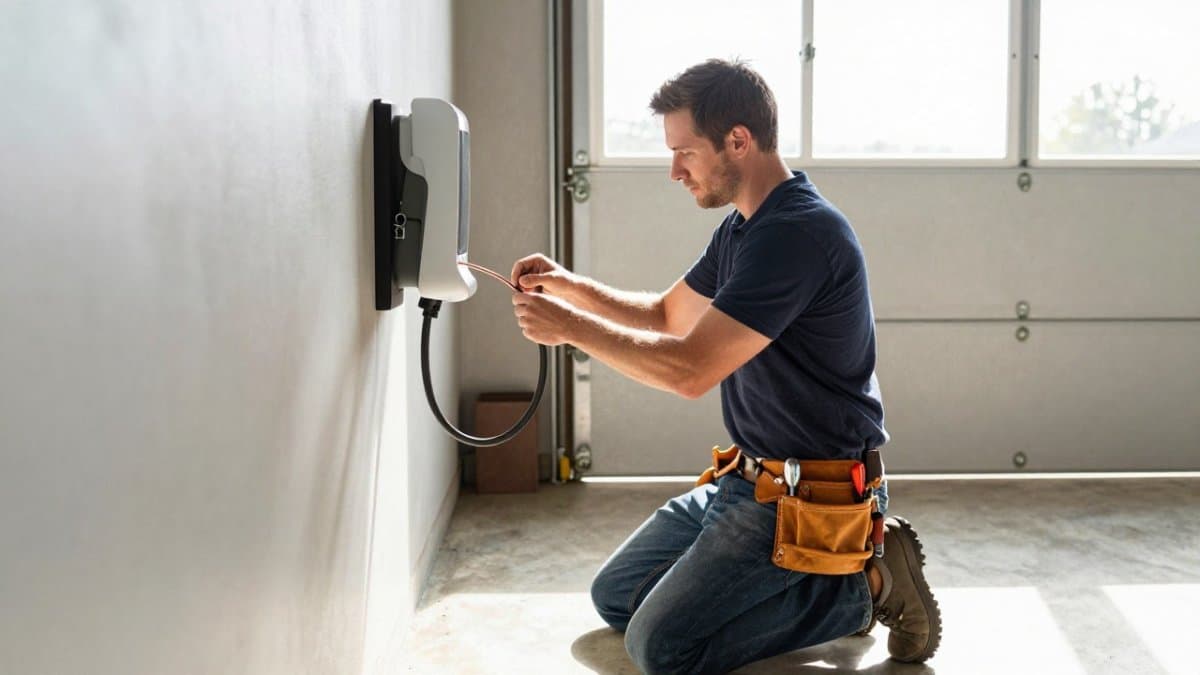
A good EV charger installation electrician checks your electrical service capacity before quoting a charger. Ask about your panel size, your daily driving distance, and where the car parks overnight before equipment is recommended.
Ask these questions:
- Will you perform a load calculation before installation?
- Do you pull the permit, or do I?
- Is the quoted price for the charger, the wiring run, or both?
- What happens if my panel needs an upgrade?
If you want to plan the full scope, you can plan home EV charger installation and talk through charger location and equipment requirements with our team. A shop that skips the load calculation is guessing, and guessing is how homeowners end up with a charger that trips the breaker.
Hot Tub Wiring Electrician: What to Ask Before You Commit
A hot tub wiring electrician handles a job with real safety stakes: water, high current, and outdoor conditions. The work involves a dedicated circuit, a GFCI breaker, proper grounding, and a disconnect within sight of the tub. Not every electrician does this work regularly.
Ask whether they have wired hot tubs before and whether they will coordinate with your spa dealer on the electrical requirements. Ask who handles the permit and the inspection.
You can plan the electrical connection for your hot tub and confirm equipment requirements, placement, and installation scope before you commit to anyone.
Requesting Quotes for Your Project
Requesting quotes from two or three contractors is the right move, and it protects you. Give each shop the same information: the project scope, photos of your panel, and your timeline. Then compare the line items, not just the totals.
A few practical tips from our side of the table. Ask how long the quote stays valid. Ask who your point of contact is once work starts. Ask for the license number in writing so you can verify it. Shops that answer these questions clearly tend to run clearer jobs.
If you would like a straightforward conversation about your project, you can tell us about your electrical project and request a quote. S&T Electrical Solutions is led by a Washington Master Electrician, holds license STELEES765B5, and handles new construction, remodels, EV chargers, RV hookups, and hot tub wiring across the Wenatchee Valley. We walk every client through the project scope from the first call to the final walkthrough.
The best contractor for your job is the one whose license checks out, whose estimate you can read line by line, and who answers the phone when something changes. Compare NCW Electric vs GC Power Co on those three points, and the decision gets much easier.
Your project deserves a contractor who explains the scope before the work starts, not after the invoice arrives. S&T Electrical Solutions brings a Washington Master Electrician's license, clear line-item planning, and specialties like EV charger and hot tub wiring to every job in the Wenatchee Valley. Get started with S&T Electrical Solutions and request a quote for your electrical project today.
Frequently Asked Questions
How do I choose between NCW Electric and GC Power Co?
Start with verifiable facts rather than brand familiarity. Pull each contractor's license number through the Washington electrician license lookup and confirm the status is active and the bond and insurance are current. Then request written electrical contractor estimates that itemize permits, labor, and materials. Compare response times, warranty terms, and whether the company handles your specific project type, such as EV charger installation or hot tub wiring. The contractor whose scope and communication style fit your job is usually the right call.
What should I ask an electrician before requesting a quote?
Ask for the license number and confirm it yourself, then ask whether permits and inspections are included in the price. Find out who performs the work (employees or subcontractors), whether the estimate is fixed or time-and-materials, and what the warranty covers. For specialty work, ask how many EV charger or hot tub installations the crew has completed and whether a load calculation is part of the quote. A contractor who answers these plainly before you sign is a good sign.
Does GC Power Co handle residential and commercial electrical work?
Confirm directly with the company, since service menus change and a website is not a contract. When you call, ask specifically about your building type and scope: panel upgrades and outlet additions for a home, or three-phase service and tenant improvements for a commercial property. Ask for a reference job in the same category as yours. If a contractor only does one type of work, that is useful information, not a red flag, as long as it matches your project.
What should I check before hiring an electrician for an EV charger installation?
Verify the license through the state lookup and confirm the company carries general liability insurance. Ask whether the quote includes a load calculation on your panel, since many homes need a service upgrade before a Level 2 charger can be added safely. Confirm the permit is pulled in the contractor's name and that the work will be inspected. Finally, ask about the charger model, the circuit amperage, and the warranty on the installation itself, not just the hardware.