
Last Updated: November 5, 2026
Quick Summary
The cost of a hot tub electrical circuit typically runs $1,165 to $2,480 for a 50-amp spa with a 40-foot run and no trenching, rising to $1,165 to $3,980 when trenching is needed. Labor, copper wire, conduit, the GFCI breaker, the disconnect box, and permit fees all drive the final price.
- Published estimates vary because they measure different scopes, so ask what each quote includes.
- Most hot tubs need a dedicated 240V circuit with GFCI protection sized to the tub's nameplate amperage.
- The disconnect must sit within sight of the tub and at least 5 feet away.
- A panel upgrade required before the spa circuit can push costs to $3,500 to $7,000 or more.
- Ask for a line-item estimate so you can compare bids against the same checklist.
Table of Contents
- What a Hot Tub Electrical Circuit Costs and What the Quote Covers
- Hot Tub Electrical Requirements That Drive the Price
- Cost to Install a 220 Line for a Hot Tub: Line-Item Breakdown
- Why a Dedicated Circuit for Hot Tub Wiring Is Non-Negotiable
- Plug-and-Play Versus Hardwired: Two Very Different Bills
- Permits, Inspection and Panel Capacity: Costs Homeowners Miss
- Finding a Hot Tub Electrician Near Me and Comparing Quotes
- Request a Quote for Your Hot Tub Circuit
- Frequently Asked Questions
What a Hot Tub Electrical Circuit Costs and What the Quote Covers
The cost of a hot tub electrical circuit depends on several factors, and the gap is almost never about the tub itself.
Most homeowners compare bottom-line numbers without checking whether those numbers cover the same work. One bid includes the disconnect and permit; the other doesn't.
Below, we'll show you how to compare estimates line by line, what each component of a hot tub circuit costs, and where the hidden expenses hide.
Published Cost Ranges and What They Actually Include
Published estimates for hot tub wiring vary widely because they measure different scopes. Angi's hot tub wiring cost guide reports a national average around $2,300 with a typical range of $1,900 to $4,200, while Harmony Electric's breakdown of hot tub electrical expenses cites a broader $500 to $2,500 for most homeowners.
A lower-cost job is typically a short run from a panel with spare capacity to a disconnect a few feet away. A higher-cost job involves trenching, conduit, a panel upgrade, and a long copper pull.
When you read any published range, ask what's inside it:
| Quote Element | Often Included | Often Excluded |
|---|---|---|
| Labor and electrician time | Yes | Overtime or weekend rates |
| Copper wire and conduit | Sometimes | Long runs over 50 feet |
| GFCI breaker | Sometimes | Panel upgrade if capacity is short |
| Disconnect box | Sometimes | Permit fees and inspection |
| Trenching | Rarely | Restoration of landscaping |
If a quote doesn't say, ask. That question separates a real estimate from a placeholder.
Hot Tub Electrical Requirements That Drive the Price
Most hot tubs need a dedicated 240V circuit with GFCI protection, sized to the tub's nameplate amperage, and that requirement is what sets the floor on your cost. A 120V plug-and-play model changes the math entirely. A 240V hardwired spa does not.
The National Electrical Code treats spas and hot tubs as a specific installation category, with rules for GFCI protection, disconnect placement, and wiring methods. Your local jurisdiction adopts its own edition of that code, and the inspector enforces it. Four things drive the price more than anything else:
- Voltage and amperage. A 240V spa drawing 50 amps needs heavier wire than a 120V model.
- Distance from the panel. Every extra foot means more copper and possibly more conduit.
- Wire route. Through a crawlspace is cheaper than under a patio.
Get the tub's spec sheet before you get quotes. The electrician needs the amperage and the manufacturer's wiring instructions, not a guess.
Cost to Install a 220 Line for a Hot Tub: Line-Item Breakdown
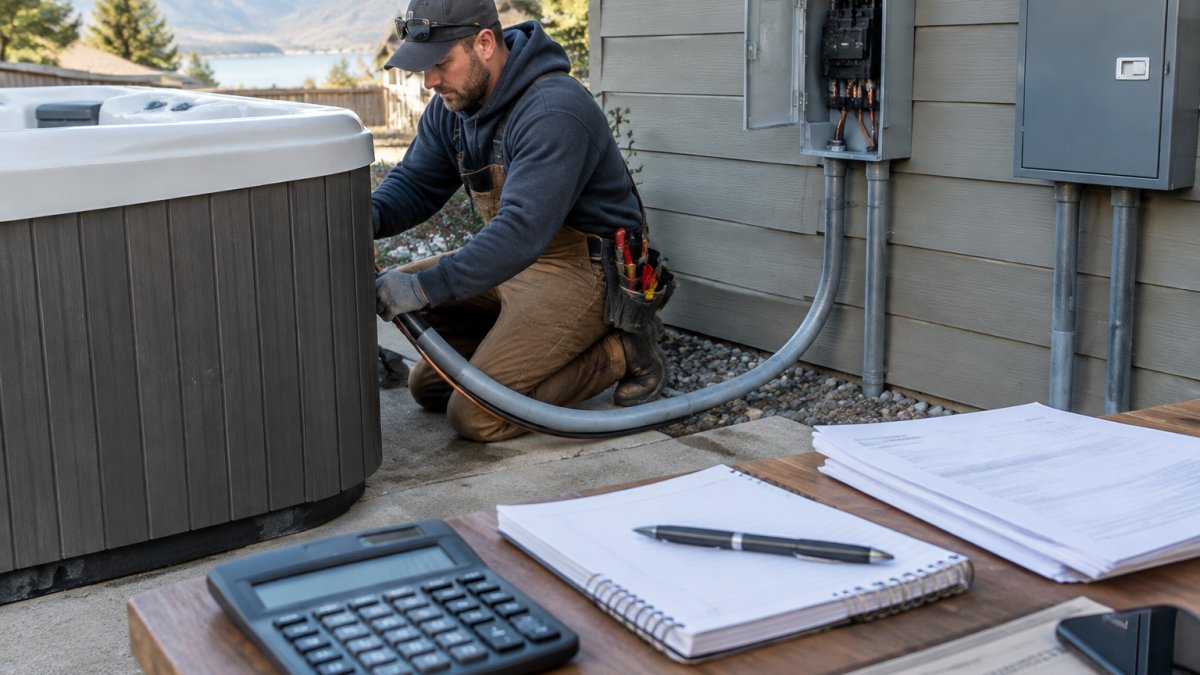
The cost of a 220 line for a hot tub generally splits into labor, wire, conduit and fittings, and electrical components, and each can move with the difficulty of the job.
Sample Itemized Estimate: 50-Amp Spa, 40-Foot Run
| Line Item | What It Covers | Planning Range (USD) |
|---|---|---|
| Labor | One or two electricians, roughly a half-day to a full day | $600-$1,200 |
| Copper wire (6 AWG, 4-conductor) | 40-foot run, plus slack at both ends | $250-$450 |
| Conduit and fittings | PVC indoors, weather-rated outdoors, boxes and straps | $80-$200 |
| GFCI breaker (50-amp, 2-pole) | Panel-mounted spa breaker | $100-$180 |
| Disconnect box | Outdoor-rated, within sight of the tub | $60-$150 |
| Permit and inspection | Local electrical permit fee | $75-$300 |
| Trenching (if needed) | 18-inch burial depth, 40 feet, surface restoration | $0-$1,500 |
| Total (no trenching) | $1,165-$2,480 | |
| Total (with trenching) | $1,165-$3,980 |
Quotes for the same tub can differ for these reasons: a short run, an open breaker space, and no digging usually costs less, while a long pull, a trench, or a panel that needs work first usually costs more.
How Each Line Moves With the Job
Labor. Electricians bill hourly or by the job. A straightforward spa hookup is typically a half-day to a full day for one or two people.
Wire. Cost scales with gauge and length. A 50-amp circuit calls for heavier copper than a 30-amp circuit, and copper prices move with the market.
Conduit and fittings. Indoors, PVC and standard boxes are modest.
GFCI breaker and disconnect. Small line items but non-negotiable.
Trenching. This line surprises homeowners.
Scenario Pricing: Five Common Jobs
| Scenario | What Changes | Typical Planning Range (USD) |
|---|---|---|
| Panel nearby, short run, open breaker space | Minimal wire, no trenching | $900-$1,800 |
| Long cable run (100+ feet) | More copper, more conduit, longer pull | $1,800-$3,200 |
| Outdoor trench through lawn or patio edge | Digging, burial conduit, restoration | $2,200-$4,000 |
| Subpanel added to reach a detached location | Subpanel, feeder, additional breakers | $2,500-$4,500 |
| Panel upgrade required first | New service panel, then spa circuit | $3,500-$7,000+ |
The only number that matters is the one your electrician writes after seeing your panel, your route, and your tub's nameplate.
Watch out: a bid that lists only a total gives you nothing to compare. Ask for the same line items shown above so two quotes can be read side by side.
Why a Dedicated Circuit for Hot Tub Wiring Is Non-Negotiable
A dedicated circuit for a hot tub means one breaker feeding one piece of equipment, with nothing else sharing it. This isn't a preference.
Hot tubs pull a large, continuous load while the heater and jets run together. Sharing that circuit risks tripping the breaker mid-soak and overloading wiring that wasn't sized for it.
A common mistake is assuming an existing 240V circuit for a dryer or old air conditioner can be repurposed.
Plug-and-Play Versus Hardwired: Two Very Different Bills
Plug-and-play models are lighter on installation but slower to heat and limited in jet power. Hardwired models heat faster and run more powerful pumps, and they carry the full electrical scope.
Best for plug-and-play: renters, small decks, and homeowners who want the lowest possible hookup cost. Skip plug-and-play if: you want strong jets, fast heat recovery, or a larger tub.
Before you buy, confirm which type the tub actually is.
Permits, Inspection and Panel Capacity: Costs Homeowners Miss
Permits and inspection are the two line items homeowners most often forget, and panel capacity is the one that turns a small job into a large one. Most jurisdictions require an electrical permit for a new spa circuit, and the fee is set locally. The permit is usually modest; the inspection is where a shortcut gets caught.
How to Verify Permit and Code Requirements Where You Live
There is no single national permit rule, and no article can tell you what your building department charges. Verify the requirements before work starts:
- Call your local building department. Ask whether a spa circuit requires an electrical permit, what the fee is, and whether the inspection is a separate scheduling step.
- Ask which edition of the electrical code your jurisdiction has adopted. Local amendments can be stricter than the base code, particularly around disconnects and GFCI protection.
- Confirm who pulls the permit. In most places the licensed electrician pulls it; in some, the homeowner can. Either way, the permit should appear as a line item on the estimate.
Watch out: a quote that skips the permit isn't saving you money. It's shifting the risk to you, and an unpermitted circuit can complicate a future home sale or insurance claim.
How an Electrician Assesses Panel Capacity
Panel capacity is the bigger wildcard, and it is not a guess. An electrician performs a load calculation that adds up existing demand, major appliances, heating and cooling, and general lighting, then compares it to the panel's rating. A spa circuit drawing 50 amps is a large addition, and the calculation determines whether the existing service can carry it.
The assessment usually comes down to three questions:
- Are there open breaker spaces? A full panel means either a subpanel or a service upgrade before the spa circuit can be added.
- Can the service carry the added load? A panel with open spaces can still be undersized for a 50-amp continuous load.
- Is the panel itself in good condition? An older panel with known reliability issues may need replacement regardless of capacity.
Subpanel Versus Service Upgrade
When capacity is short, there are two paths, and they carry very different costs:
- Subpanel. A smaller panel fed from the main service, installed closer to the hot tub. This shortens the spa circuit run and can be the cheaper fix when the main service has capacity but the panel is full or far away.
- Service upgrade. A new main panel, often to 200 amps, when the existing service cannot carry the added load. This is a separate project with its own permit and inspection, and it is the reason two neighbors with identical tubs can get very different quotes.
If your electrician flags capacity, review electrical panel replacement and 200 amp upgrades in Wenatchee before you commit to the spa circuit, and read our breakdown of electrical panel upgrade costs so the second number doesn't surprise you.
What the Inspection Actually Covers
The inspection is not a formality. The inspector verifies the circuit was installed as permitted and meets the adopted code, including GFCI protection, disconnect placement, wiring methods, and burial depth for any underground run. A failed inspection means rework, a re-inspection fee, and delay, which is why permit and inspection belong in the original scope.
Finding a Hot Tub Electrician Near Me and Comparing Quotes
Searching for a hot tub electrician near me usually returns a long list, and the differentiator isn't price. It's whether the electrician will put the scope in writing. Ask for a line-item estimate, not a lump sum, and compare three bids against the same checklist.
Use this to score each quote:
- Amperage and voltage stated, matched to the tub's nameplate
- Wire gauge and run length specified
- Conduit type and route described
If a bid can't fill that list, it isn't comparable. Our guide on how to find a reliable residential electrician walks through the vetting questions worth asking before you sign.
Request a Quote for Your Hot Tub Circuit
The honest answer to what a hot tub circuit costs is that it depends on your panel, your yard, and your tub, and no published average can see any of those.
At S&T Electrical Solutions, we're led by a Washington Master Electrician and licensed as a Washington electrical contractor, and hot tub wiring is one of our regular installations. To see how we approach the work, review our hot tub wiring service in Wenatchee.
Ready to stop guessing? Tell us about your electrical project and we'll walk your site, confirm capacity, and put the numbers in writing.
Frequently Asked Questions
How much does it cost to install electrical wiring for a hot tub?
The bill depends on your cable run length, whether your service panel has spare capacity, permit fees and whether the tub is hardwired or plug-and-play. A licensed electrician can give you an accurate figure after reviewing your site.
Does a hot tub need its own dedicated circuit?
Yes. A dedicated circuit for hot tub wiring means the tub has a circuit breaker reserved for it alone, with nothing else sharing the load. Hot tubs draw high continuous current, and the National Electrical Code treats them as a specific installation with GFCI protection, disconnect and bonding rules. Sharing a circuit with other equipment risks tripping, overloads and a failed inspection. The dedicated circuit, breaker and GFCI protection are typically the largest fixed line items in the estimate.
Can my existing electrical panel support a hot tub circuit?
Sometimes, but it depends on spare breaker spaces and the total load calculation for your home. A 240V hot tub circuit needs a double-pole breaker, and older panels may have no open slots or may already be near capacity. If the panel cannot take the load, a subpanel or service upgrade adds cost and time to the project. A licensed electrician should run the load calculation before you buy the tub, so you know whether the panel is ready or needs work.
Does the distance from the electrical panel affect hot tub wiring costs?
It is one of the biggest cost drivers. Every extra foot of cable run adds copper wire, conduit and labor, and long runs may require a larger wire gauge to limit voltage drop. A tub 15 feet from the panel with an easy path is a very different job from one 80 feet away across a finished patio that needs trenching. Ask each electrician to state the measured run length in the quote so you can compare estimates like for like.
How do I get an accurate estimate for hot tub electrical installation?
Ask for an itemized written quote that separates labor, wire and conduit, GFCI breaker, disconnect, permit fees and any panel work. Provide the tub's electrical specification sheet, the planned location and the panel's location and amperage. A hot tub electrician near me search should lead you to a licensed contractor who will visit the site or ask for photos before pricing, because run length and panel condition cannot be judged from a phone description. Confirm the quote states who pulls the permit and who schedules inspection.
Your hot tub should be a place to unwind, not a source of electrical worry. Get the circuit planned correctly the first time, with a clear scope and no surprises on the invoice. Get started with S&T Electrical Solutions and request a quote for your hot tub circuit today.