
Table of Contents
- Hiring Electrical Subcontractors for New Construction: Where to Start
- What a Solid Electrical Subcontractor Scope of Work Covers
- Licensing, Insurance, and Bonding: The Non-Negotiables
- Questions to Ask an Electrical Contractor Before You Sign
- The Electrical Subcontractor Bid Checklist for Apples-to-Apples Comparison
- Building the Electrical Subcontractor Project Schedule
- Quality Control, Code Compliance, and Inspections
- Conclusion: Vetting Beats Rushing on Every Build
- Frequently Asked Questions
Last Updated: October 21, 2026
Hiring Electrical Subcontractors for New Construction: Where to Start
Hiring electrical subcontractors for new construction means vetting, selecting, and contracting a licensed electrical firm to handle wiring, rough-in, and power systems before the walls close up. Get it wrong and you inherit schedule delays, failed inspections, and change orders that eat your margin.
Below, we'll show you how to evaluate an electrical subcontractor before you sign, from scope of work to bid comparison to inspection day. Price is the last thing you should compare.
What a Solid Electrical Subcontractor Scope of Work Covers
A solid electrical subcontractor scope of work defines every deliverable in writing: panel and service size, branch circuits, device locations, low-voltage pathways, fixture installation, permit responsibility, and who pays when plans change. Vague scopes are where disputes start.
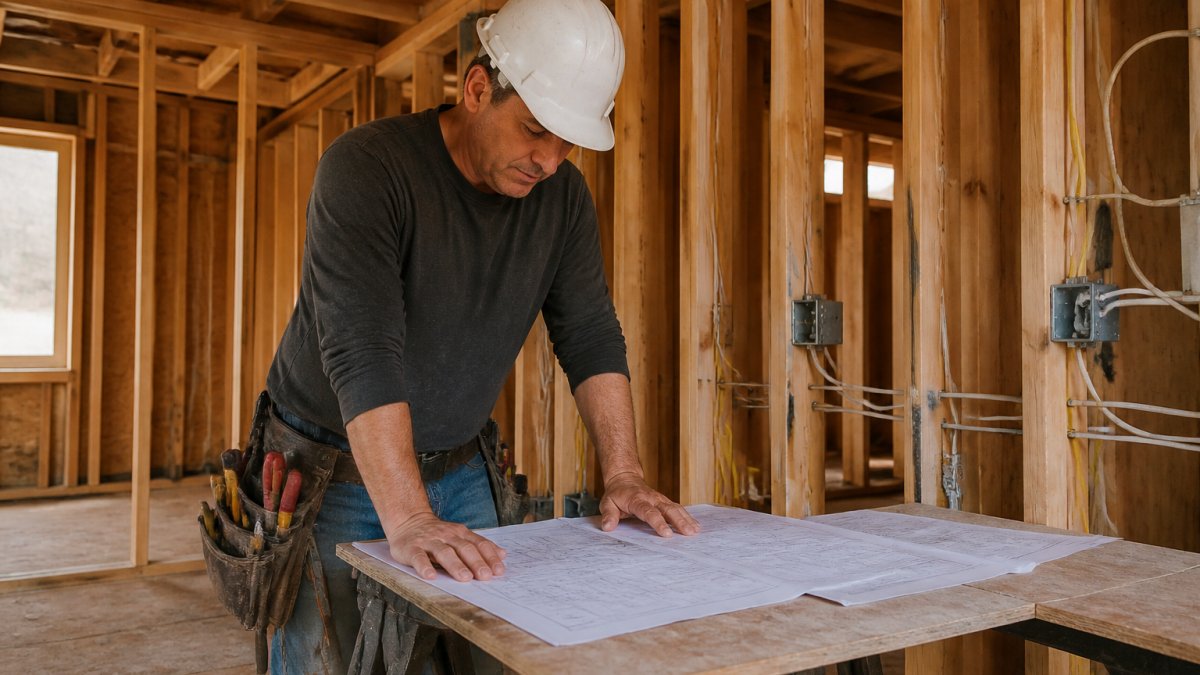
The scope should name the electrical subcontractor's responsibilities line by line. Insist on these sections:
- Service entrance and panel schedule, including available capacity for future loads
- Rough-in locations for outlets, switches, and dedicated circuits
- Low-voltage and telecom cabling pathways, separate from line-voltage runs
Residential vs. Commercial Scope Differences
Residential scopes center on service size, arc-fault and ground-fault protection, and device layout. Commercial scopes add load calculations, three-phase service, emergency lighting, and coordination with fire alarm and data trades. A subcontractor strong in new homes is not automatically strong in commercial work, ask which side of that line they actually work on.
Licensing, Insurance, and Bonding: The Non-Negotiables
Verify three things before any contract: an active electrical license in the jurisdiction where the work happens, general liability and workers' compensation coverage at limits your project requires, and a surety bond if your contract calls for one.
License verification that actually holds up
Licensing requirements vary, some states license at the state level, some delegate to counties or cities, and some require a separate master or journeyman credential. Check the license through the issuing authority's public lookup, not a certificate image, and confirm three things: the license number matches the legal entity name on the contract, it is active on the date work starts, and the classification covers the work type.
The National Electrical Contractors Association publishes guidance on contractor qualification that helps builders frame the right questions, and most state contractor boards publish their own verification steps.
Insurance: what to require and how to confirm it
Request a certificate of insurance before award and read it for four items:
- General liability at limits that match your project's exposure, with your company named as additional insured.
- Workers' compensation covering every worker who will set foot on your site, a lapsed policy can leave you exposed if a worker is hurt on your site.
- Automobile liability if the sub will drive on site or haul materials.
Then call the carrier or agent listed on the certificate and confirm the policy is active, the dates cover your project window, and the additional-insured endorsement is in force. A certificate listing coverage the carrier has never heard of is worse than none.
Bonding, indemnity, and payment terms
Bonding matters most on larger projects, where a performance bond protects you if the electrical subcontractor walks off the job. Ask for the bond amount, the surety's rating, and confirmation the bond names your project.
Read the indemnity clause and payment terms together. An indemnity clause broader than the sub's insurance coverage is a promise the sub cannot keep, and paying in full before final inspection removes your leverage on punch-list work.
A pre-award compliance checklist
Before you sign, confirm in writing:
- Active license number, verified through the issuing authority, matching the contracting entity.
- Certificate of insurance with your company as additional insured, confirmed with the carrier.
- Workers' compensation coverage confirmed active for the project window.
- Bond amount and surety confirmed, if the contract requires one.
- Indemnity language reviewed against the insurance limits.
- Payment terms and retainage tied to inspection milestones and closeout documents.
Builders who run this checklist before award spend an hour and avoid disputes that otherwise surface after the walls are closed.
Questions to Ask an Electrical Contractor Before You Sign
Ask an electrical contractor these questions before signing: who pulls the permit, who supervises the crew on site, how many other projects run at once, what their re-inspection record looks like, and who answers the phone when something goes wrong at 4 p.m. on a Friday.
Run through this list in the interview:
- Is your license active in this jurisdiction, and can you send the number?
- Who is the journeyman or master electrician supervising my project?
- How many crews do you run, and how many projects are active right now?
- What is your process when an inspection fails?
- Can you provide three builder references from the last year?
- How do you handle change orders and who signs them?
- What is your typical rough-in timeline for a home this size?
That last question matters more than builders expect. A subcontractor who cannot give you a realistic rough-in window is either guessing or overbooked. Both are problems.
The Electrical Subcontractor Bid Checklist for Apples-to-Apples Comparison
An electrical subcontractor bid checklist compares every proposal against the same line items: scope inclusions, exclusions, material allowances, permit costs, change-order rates, and schedule commitments. Without one, the lowest bid is often the one that excluded the most work.
Use this table to score each bid side by side before you award anything:
| Bid Item | What to Compare | Red Flag |
|---|---|---|
| Scope inclusions | Line-by-line match to your scope document | Vague language like "typical wiring" |
| Exclusions | Written list of what is not covered | Long exclusion list on core work |
| Permit costs | Who pulls and pays | Silent on permits |
| Material allowances | Fixture and device allowances stated | No allowances at all |
| Change-order rate | Hourly rate plus markup, in writing | "To be discussed later" |
| Schedule commitment | Rough-in and trim dates | No dates offered |
| Insurance and bond | Certificate and bond amount | Certificate only, no carrier contact |
The lowest number on the page rarely wins. A bid that excludes fixture installation or permit fees will cost more by closeout. Compare total scope, not total price.
Building the Electrical Subcontractor Project Schedule
An electrical subcontractor project schedule maps rough-in, inspection, and trim-out dates against the builder's master schedule, with float for inspection turnaround. Electrical work sits on the critical path in most new builds, so a slipped rough-in pushes drywall, paint, and everything after it.
The four electrical phases on a new build
- Underground and service coordination. Before the slab or foundation work closes, the electrical sub coordinates the service entrance location, meter base, and any underground conduit with the utility. Miss this window and the service lateral becomes a trenching problem later.
- Rough-in. With framing up and the roof weather-tight, the sub runs conduit, boxes, and cable through the stud bays. Rough-in must finish and pass inspection before the walls close.
- Trim-out. After drywall, paint, and flooring, the sub installs devices, fixtures, and panels. Trim-out depends on finish schedules, so a delayed fixture selection delays the sub.
- Final inspection and closeout. The sub corrects punch-list items, delivers as-built drawings, and coordinates the final inspection that clears the certificate of occupancy.
Build the schedule backward from your drywall date. The electrical subcontractor needs framed walls, a weather-tight roof, and cleared pathways before crews arrive, and utility coordination in phase one must happen weeks earlier than most builders plan.
Coordinating rough-in with other trades
Rough-in collides with plumbing, HVAC, and low-voltage trades competing for the same stud bays. Hold a coordination walk before rough-in starts with every trade present, and mark penetration points and panel locations on the framing so nobody drills through another trade's work.
The dependencies that most often slip:
- Framing and roof: electrical rough-in cannot start until walls are framed and the roof is weather-tight. A framing delay is an electrical delay, whether or not the sub is at fault.
- HVAC and plumbing: mechanical rough-in and electrical rough-in share the same window. If HVAC is late, the electrician either waits or works around ductwork that will later move.
- Low-voltage and telecom: data, security, and audio pathways should be run in the same window as line-voltage rough-in, before insulation. Separating them into a second mobilization adds cost and schedule risk.
Utility coordination and inspection float
Service coordination with the utility is its own schedule track. Confirm the meter base, service entrance, and any transformer or pedestal requirements early, because utility schedules rarely bend to a builder's timeline. Submit the service request as soon as the foundation is set so utility work runs in parallel with framing.
Inspection float deserves the same treatment. Most jurisdictions schedule inspections within a few business days, but that window varies, and a failed inspection resets the clock.
What to put in the subcontract schedule
The schedule commitment in the subcontract should name dates, not durations: rough-in start, rough-in complete, inspection requested, trim-out start, and final inspection. It should also state who owns each dependency, who confirms the roof is weather-tight, who schedules the inspection, who calls the utility.
Quality Control, Code Compliance, and Inspections
Quality control on electrical work means three checkpoints: a self-inspection by the subcontractor before calling for inspection, a builder walk of the rough-in, and a final walk before handover.
The electrical code adopted in your jurisdiction governs the work, and adoption timelines differ by state and city. The National Fire Protection Association maintains the National Electrical Code that most jurisdictions base their rules on, though local amendments are common.
A failed inspection costs more than the re-inspection fee. It costs days on the schedule, and days on a new build compound. Ask every electrical subcontractor for their re-inspection history and treat a pattern of failures as disqualifying.
Conclusion: Vetting Beats Rushing on Every Build
The pressure to break ground fast pushes builders toward the first available electrical subcontractor rather than the right one.
At S&T Electrical Solutions, every project starts with a clear scope conversation, led by a Washington Master Electrician and backed by direct communication with owner Steven Sabedra.
Request a quote from S&T Electrical Solutions and get a scope you can actually compare against every other bid on your desk.
Frequently Asked Questions
What should you check before hiring an electrical subcontractor?
Start with the license. In Washington, verify the electrical contractor license and the Master Electrician credential through the state's licensing database, then confirm general liability and workers' compensation coverage with a certificate sent directly from the insurer. Ask for three recent projects of similar size and type, and call those builders. Check capacity too: how many crews they run and how many active jobs they carry tells you whether your new construction timeline is realistic. Finally, get the scope of work and payment schedule in writing before any work begins.
What should an electrical subcontractor's bid include?
A bid you can compare line by line should list labor and material separately, permit fees, temporary power, fixture and device installation, panel and service work, low-voltage and telecom cabling if in scope, and any allowances for fixtures the owner supplies. It should state exclusions clearly (trenching, fire alarm, data termination) and note the bid's validity window. Ask every bidder to use the same scope document so you are comparing the same work. A single lump-sum number with no breakdown is hard to evaluate and usually hides gaps that turn into change orders later.
When should you bring an electrical subcontractor into a new construction project?
Earlier than most builders do. Bring the electrical subcontractor in during preconstruction, before the foundation is poured, so service size, panel location, meter placement, and utility coordination are settled while changes are still cheap. On the schedule itself, rough-in follows framing and roofing, and the electrical crew needs the building dried in before pulling wire. Trim-out comes after drywall and paint. Locking those windows into the master schedule at bid time prevents the electrical crew from arriving to a site that is not ready.
How do you verify an electrical contractor's license and insurance?
Look up the contractor's license number in your state's online licensing system and confirm it is active, matches the legal business name on the contract, and carries the right classification for your project type. For insurance, request a certificate of insurance naming you or the property entity as additional insured, and have the insurer email it directly rather than accepting a PDF from the contractor. Confirm workers' compensation coverage is current. If a subcontractor cannot produce these documents quickly, that is your answer about how the rest of the project will go.